The battery is the heart of every electric scooter. It determines how far you can ride, how quickly your scooter accelerates, how long it lasts before replacement, and even how safe the scooter is during daily use. If you’re thinking about buying an electric scooter or simply want to understand how your scooter’s battery works, learning the difference between Lithium-ion (Li-ion) and Lithium Polymer (LiPo) batteries is essential.
This guide breaks down both battery types in simple terms and explains what each one means for performance, safety, lifespan, and long-term value.
The Two Main Types of E-Scooter Batteries
Electric scooters use two major battery technologies:
1. Lithium-ion (Li-ion)
The most common battery type used in modern e-scooters.
2. Lithium Polymer (LiPo)
A lighter, more flexible battery type often used in high-performance models.
Both belong to the lithium battery family, but the chemistry, construction, safety, and performance differ significantly.
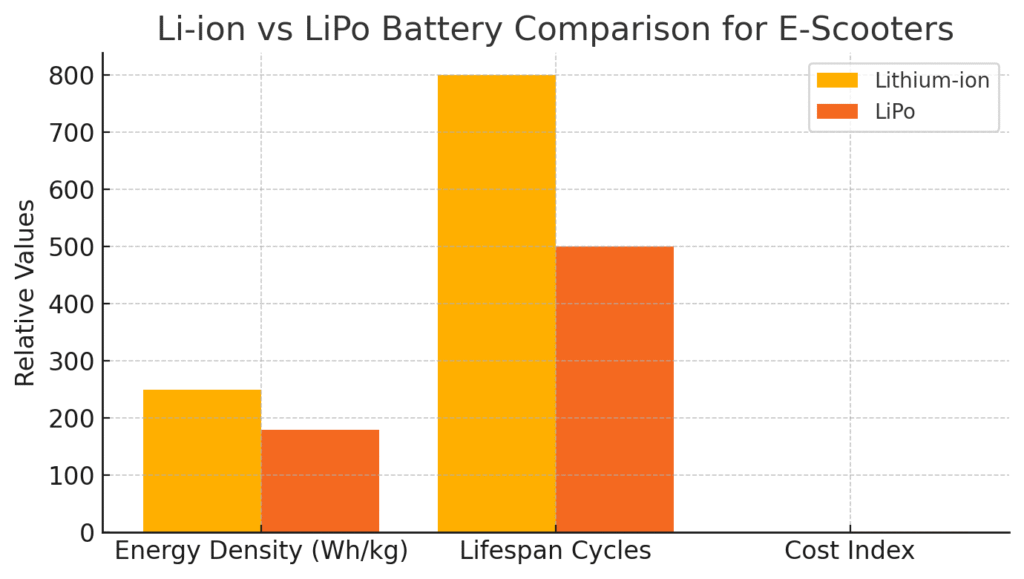
To give you a quick visual comparison, here’s a graph comparing energy density, lifespan cycles, and cost index:
What Is a Lithium-ion (Li-ion) Battery?
Lithium-ion batteries are the most widely used power source in electric scooters. They’re also used in electric cars, laptops, and mobile phones due to their high energy density and long lifespan.
Benefits
- Longer lifespan (typically 600–1,000 charge cycles)
- Higher energy density = longer range
- More stable and safer with built-in protection circuits
- Better performance in cold weather
- Low self-discharge rate
Drawbacks
- Slightly heavier than LiPo batteries
- Can heat up under extreme loads
- More rigid shape = less design flexibility
For most daily commuters, Li-ion batteries are ideal due to their reliability and efficiency.
What Is a Lithium Polymer (LiPo) Battery?
Lithium Polymer batteries use a gel-based electrolyte instead of liquid, allowing more flexible shapes and lighter weights. These are common in drones, RC vehicles, and sometimes high-performance e-scooters.
Benefits
- Lighter weight improves acceleration and hill performance
- Higher discharge rate, ideal for strong bursts of power
- Flexible design allows slim or compact battery packs
- Better for performance scooters
Drawbacks
- Shorter lifespan (around 300–600 charge cycles)
- More sensitive to overcharging and heat
- Higher chance of swelling if poorly maintained
- Slightly more expensive
LiPo batteries give you speed—but they require more care.
Key Differences at a Glance
1. Energy Density
- Li-ion: Higher energy density → more range per charge
- LiPo: Lower energy density → slightly shorter range
2. Lifespan
- Li-ion: Longer cycle life
- LiPo: Degrades faster
3. Weight
- LiPo: Lighter, better for portability
- Li-ion: Heavier but more stable
4. Safety
- Li-ion: Built-in protection, safer long term
- LiPo: More sensitive, higher risk of damage if misused
5. Cost
- Li-ion: More affordable
- LiPo: Slightly more expensive to produce
Which Battery Is Better for Daily Riders?
Li-ion is the best choice for MOST riders.
You should choose a Li-ion battery if you want:
- Longer battery life
- More ride range
- Better safety
- Lower long-term cost
- Reliable daily commuting
Li-ion batteries dominate the electric scooter industry because they offer the best balance of safety and performance.
Who Should Choose LiPo Batteries?
LiPo is better for performance enthusiasts.
Choose a LiPo battery if you want:
- Faster acceleration
- High torque for steep hills
- Lightweight design
- High-performance rides
LiPo batteries are commonly found in racing-style scooters or powerful off-road models.
Charging Differences: Li-ion vs. LiPo
Li-ion Charging
- Very stable
- Slower charging (protects lifespan)
- Built-in BMS prevents overcharging
LiPo Charging
- Charges faster
- Requires precise charging
- Risk of swelling if poorly maintained
Always use the charger recommended by the manufacturer—never mix chargers between scooters.
Safety Considerations
Safety Strength: Li-ion
- Better temperature control
- Lower chance of swelling
- Widely tested and stable
Safety Warning: LiPo
- More likely to overheat
- Sensitive to punctures
- Needs careful charging habits
Modern scooters with LiPo batteries usually include advanced safety systems to reduce risks, but users must still be cautious.
Range and Performance: What to Expect
Li-ion scooters typically offer:
- Longer range per charge
- Stable performance even under moderate load
LiPo scooters typically offer:
- Faster acceleration
- Higher peak power
- Better hill climbing
This is why many entry-level commuting scooters use Li-ion, while high-performance models favor LiPo.
Battery Lifespan: How Many Years Do They Last?
Li-ion
Most Li-ion batteries last 2–4 years with normal use.
LiPo
LiPo batteries typically last 1.5–3 years, depending on riding style and charging habits.
Cost Comparison Over Time
Li-ion batteries have lower long-term costs because they last longer and degrade more slowly.
Even if LiPo batteries offer better performance, they may require replacement sooner—raising long-term costs.
Maintenance Tips for Both Battery Types
1. Avoid full discharges
Try not to let the battery hit 0%.
2. Don’t charge immediately after a ride
Let the battery cool for 10–15 minutes.
3. Store at 40–60% charge if not using for weeks.
4. Keep away from extreme temperatures
Heat shortens battery lifespan.
5. Use only certified chargers
This is especially critical for LiPo batteries.
Which Battery Should You Choose? Final Verdict
Choose Li-ion if you want:
✔ Reliability
✔ Long range
✔ Long lifespan
✔ Lower cost
✔ Safer daily rides
Choose LiPo if you want:
✔ High power
✔ Fast acceleration
✔ Lightweight performance
✔ Sport-style riding
For most people—commuters, students, and daily riders—Lithium-ion (Li-ion) is the best, safest, and most cost-effective choice.